Posts

Showing posts with the label Brainstorming

Husbands As Story Fodder, Part 2

Last week, I talked about how my husband affects my writing day and what contribution he has to my books (which is not very much). But he does indirectly help me a ton in one department: I have a very good template for a happy, healthy, long-term relationship, which I can either apply to develop a convincing romance, or I can break to totally screw over my characters. At present, fanciful daydreams excluded, I have two proper novels I'm working on. One involves a couple that falls in love during the book, and the other involves an already-married couple that's trying to get back to each other. In an effort to avoid the eye-rolling tropes romance can fall into, and to try and make these characters real and lovable, I ask myself, "What would I do if it was Rick?" My rule of thumb for romantic plots is to make the reader (myself, really) fall in love with the characters as they fall in love with each other. So what better way than to include stand-ins for the things...
Husbands As Story Fodder, Part 1

I'm sorry for missing my post last week. I'd like to blame it on a scheduling snafoo or some dramatic emergency at work, but the truth is I just plain didn't do it. I didn't feel like writing because my husband flew off to China for work that morning, which is something he does every few months. He'll be gone for one or two weeks, and theoretically the quiet evenings would be the perfect time to get tons of writing done. The reality is that my routine gets so disrupted, I spend the entire time moping, eating junk food, and watching Grey's Anatomy. As cliche as it is, I can't sleep well when he's not here, because the bed is big and empty and we don't watch our shows together at night--and by the end of the week I'm sleep-deprived and running on fumes. This got me thinking about how much my relationship with my husband influences my writing. There's the real-life stuff (how he affects the daily routine, his role in idea-generation and prob...

More Stories Should Play Around With Non-Earth Settings

Image
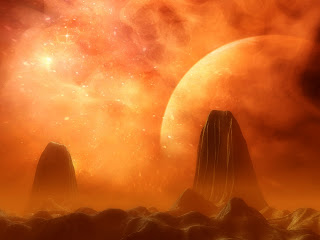
Sure, Tatooine has two suns, Arrakis is a giant desert full of sandworms and spice mines, and Doctor Who once visited a planet made of diamonds --but characters don't have to be traveling on spaceships to have adventures in non-Earth settings. Sci-fi has always done a pretty good job imagining strange and fantastic worlds, which always makes me happy, yet at the same time I've realized there's some cool real science that could be used to expand sci-fi and fantasy settings a lot more than is often seen. (And as cool as Star Wars can be, it's worth mentioning how silly it is that most of the places are mono-settings: ice planet, swamp planet, city planet...) Now, all of the pictures you see here are from the public domain. I want to show you a few other things, too, but I'm going to send you to the original sources (or at least, the links where I found them). It all started when I stumbled upon this reddit thread discussing plant colors on other (theoretica...

Things I Learned From Vet: Throwing Wrenches

Exciting plots are all about unexpected twists and complications. Just when it seems things are going right, boom, a new problem for the characters to deal with, or a game-changing revelation. Some general writing advice suggests that if you get stuck, throw a wrench in the scene and see what happens. Vet medicine involves plenty of wrenches, too. Maybe it's helped me developed the skill of dealing with the wrenches, but I imagine most jobs do. It sure gives good fodder for creating the wrenches, though. Smooth day? Dog fight or car crash arriving in ten minutes. Classic symptoms? Diagnostic tests negative for the suspected disease. Seen a few guinea pigs and rabbits? How about a sick sugar glider. (Staff: "I didn't even know that was an animal.") All of these can be turned into plot devices: Smooth day? Dog fight or car crash arriving in ten minutes. - Finally solved a plot problem or resolved an argument? Explode something in the room. Classic sympto...

Romantic Scenes That Don't Turn Into A Rom-Com

Ready for my writing "life lesson" of the week? Today I had an epiphany about the difference between a scene that creates sexual tension in a sweet and romantic way, versus one that's silly and rom-com-y. Or at least, one of the main differences (plot and relationship context is important, too). Short Version:  Rom-com-y = accidental touches (tripping and falling into someone's arms, colliding with their hand when both reaching for something) Deliberate = intentional touches (gently moving someone aside, rubbing them while they're shivering)  Long Version: I had to rewrite a scene where the characters have a physical connection. A Moment, if you will. I've had to rewrite this a zillion times because of unrelated Plot Reasons. Each change involved a new setting, which necessitated a whole new scenario for the Moment, so I've had to brainstorm about this a lot. In the early drafts, the easiest ways to get these two characters to touch seemed to ...

Who To Represent?

There are a lot of topical issues close to my heart, and a lot of areas of diversity and representation I care about. This has wound up seriously stumping me more than once, in an unexpected way. Here's my most recent dilemma... I really like sensitive men. (See: husband) One of the issues I care about is the image of masculinity in society, and how men are expected to act in specific, "manly" ways, or else they're less of a person. So I looooove subverting this by showcasing sensitive, emotional male characters, and getting deep into their fears and pains and using such things to drive their story. I conversely hate showing sensitive, emotional women, because sadly that's how women have always been portrayed--usually with the implication of being weak-kneed and needing a lot of support for their men. Thus, I tend towards soft, gentle male characters and tough, independent female characters. Because the heavy emotional stuff is more weighted on the men, those ...

My Idea Farm

I like to plant ideas into an idea farm to grow. Authors are frequently asked about how they get their ideas. As far as how I get mine... I'm not so sure. They usually strike me when I'm reading or watching something else, some kind of "what if" spin on what's in front of me. Occasionally news, especially science news, creates sparks. Regardless, whenever I do come up with something, into the idea farm it goes. What on earth is the idea farm? Currently, it's a google doc. That way I can access it when I'm out and about (which used to include via my tablet while in vet school lectures heh). I toss whatever comes to mind in there with a bold header for quick reference, eg "character," "story element," "culture," etc. If it came from a specific inspiration, I'll try to mention it so I don't forget, such as "Like that SG-1 episode" or "from that TED talk on xxxxx." Basically, I've got a lot of ...

Incongruity As A Brainstorming Tool

Something that really clicked for me in making story elements interesting is the process of asking myself, "What wouldn't you expect?" I've had a lot of trouble getting stories off the ground in the past. Sometimes I'll have one character I love, but can't find much spark for the rest of the cast. Or maybe I'll have characters, but nothing interesting about where they live and work. I've spent countless hours pondering how to turn a main cast member from "pretty interesting" to "totally lovable," and hitting my head against a wall. Nothing kills stories faster for me than persistently feeling lukewarm about parts of them. But one day I tried a new approach. I'm pretty sure it was inspired by a Writing Excuses episode, but I can't remember which one. I sat myself down and said, "What's the opposite of what you'd expect?" The answer was surprisingly attractive. I asked myself again, and again. Everything...

For A Sci-Fi Writer, I Have A Hard Time With Plot

Science fiction is largely about ideas. Whether that's examining the human condition through a fictional lens, or taking a "what if" scenario and seeing where it goes, most sci-fi really makes you think. All the great, "classic" sci-fi I've read is very much ideas-based. Asimov, Heinlein, Frank Herbert, Phillip K. Dick, to name only a few. Even Ender's Game, a young adult novel, is very ideas-driven. Neuromancer, one of my more recent reads, is breathtakingly detailed and deliciously inventive, but again, ideas are the name of the game. For someone who thrives off these things so much, I sure lack in ideas. Or at least, big concept ideas. I feel like I could never create something as intricate and creative as those SF giants. I'm always impressed by other writers who dream up entire cultures and worlds. It's so easy for some people! One thing flows into another and before you know it, the worldbuilding is practically writing itself. Traditi...