Posts

Showing posts with the label Science Is Awesome

Old Sci-Fi Movie Drinking Game

Science fiction has been pushing the boundaries of human imagination for over a hundred years, always presenting us with "what if?" and "imagine!" Even when our scientific awareness of the universe could barely tell up from down, writers toyed with what technology might be able to do and what life on other planets might mean. While this is wonderful and commendable, it's also, a lot of the time, hilarious. The golden age of science fiction produced a lot of very silly movies. They were ahead of their time, but looking back, cinematography has advanced as much as scientific knowledge. Once upon a time, my husband and I gathered a few classic movies, including Forbidden Planet and The Day The Earth Stood Still. They proved so wonderfully, lovably ridiculous, thus was born the Old Sci-Fi Movie Drinking Game. Here are the rules. Drink when you see... Random shots of the space ship Blatant sexism, including but not limited to: girl gets hysterical; girl is u...

Setting Inspiration: Venus

Image
A while back, I gushed about how awesome the solar system is , and gave a very brief overview of details I've learned about each planet. However, I felt I needed to give some extra attention to one of the planet that most "wows" me: Venus. (There may be another post in the future about the ice giants, which are a close second). The thing about Venus is how ferociously, cosmically, scorchingly inhospitable it is. I mean, all the not-Earth-or-Mars planets are pretty inhospitable, but Venus impresses me beyond the rest. Acid rain and metal snow, a molten surface that our probes can barely survive--it's fierce, man. I never thought much of it until I watched a planetarium show that demonstrated these aspects in blazing panoramic color. Venus has a few interesting quirks. The sun rises in the west and sets in the east. It has no moons. The planet itself rotates slowly, but the atmosphere whips around at hurricane speeds. A lot of old sci-fi speculated Venus to ...

Baby Alpacas

I want to leave you with this little tidbit today. You know how when cows give birth, it's called calving? Guess what it's called when alpacas give birth. Unpacking. To use it in a sentence (a real quote from a veterinarian): "I have to go unpack an alpaca."

PSA: Your pets don't need grain-free diets.

More than half of my clients proudly tell me they've switched their pets' food to "grain-free." This is often in conjunction with a bit of puzzlement at how the pet's allergic skin or intestinal issues haven't resolved yet. Even my mother's vet told her to try grain-free for their little dog's weepy eyes. Guess what? It didn't help. Because it doesn't help. Because it doesn't matter. There's no science-based evidence that grain has effects on pets. It's a big fad in humans, and anyone with Coeliac disease will tell you how aggravating it is that healthy people cling to it as this trendy superfood type deal (though it's also made gluten-free products much more mainstream and available, so that's a plus). So already, the benefits of grain-free are largely exaggerated even in humans. In pets? Nada. In the grand tradition of vet students, I slightly threw out all but the most essential of my notes, so I no longer have specif...

Odd Surgeries You Didn't Realize We Can Do In Pets

Medical technology gets more newfangled every day, and some of the things we can do in human medicine is getting close to Star Trek. But something people tend to forget is that most things that can be done in humans, can also be done in animals. They usually aren't , but that's not because we can't ! However, here are some of the more common advanced or interesting surgeries we tend to do on pets... 1. Rewire salivary glands to act as tear ducts. If the tear ducts don't work, the eyes get all dried out and then they stop working, too. Surgeons can work their magic to re-plumb the tiny ducts from the salivaries up into the eyes instead of the mouth. Then the pet cries when it eats. Not kidding. 2. Plant chemotherapy beads or gel inside their brain. I mention this one because I actually had a patient go through brain surgery. The neurosurgeon did a bunch of CT scans to pinpoint the tumor, then they went in through an area a bit above and between the eyes. I believe...

PSA: Cats and Wet Food

For some reason, clients all think wet food is bad to feed your cats. I ask what they're feeding, and they shuffle around guiltily when they admit they give canned food along with the dry. It completely baffles me why this happens. I guess pet owners go around telling each other about how wet food is bad for the teeth. Kind of like how they tell each other grain-free will fix all your pets problems. Well, here's a tip for you: Wet food is really good for cat kidneys and bladders. Feed them both. Teeth, I can fix. If I can't clean them, I can take them right out. Kidneys, on the other hand? 50% of all cats die of kidney failure. There's an adage that any cat who lives long enough will get kidney disease. Because my stack of vet school notes was about as tall as I am, you may not be surprised to learn I didn't ship them all back with me when I left New Zealand. Therefore, I no longer have access to the names and dates of the key studies regarding feline kidney...

Neutron Stars

Image
Neutron stars are fascinating. Their most distinctive feature is how dense they are. The internet told me once that a spoonful of neutron star could weigh a billion tons (or maybe it was tonnes). To quote Wikipedia (links and all)... A neutron star is the collapsed core of a large star (10–29 solar masses). Neutron stars are the smallest and densest stars known to exist. [1] With a radius on the order of 10 km , they can, however, have a mass of about twice that of the Sun . This is not a neutron star, sorry. It's here for atmosphere. And because Wikipedia is more articulate than me trying to paraphrase the same information, Wikipedia also has this to say about their origins: They result from the supernova explosion of a massive star , combined with gravitational collapse , that compresses the core past the white dwarf star density to that of atomic nuclei . If you're like me and can't resist all those Wikipedia links, I have to say this spacey stuff is real...

Fun Vet Fact Of The Day

Image
Okay, I have to share my favorite veterinary fun fact. It's the one bit of trivia I can pull out at a party (not that I ever go to parties), and always makes clients giggle. If you scruff ferrets, it makes them yawn. Every time. I use it to look at their teeth. It's super cute. That's all.

Space Travel Is Really Bad For You

Image
It turns out space travel wrecks the human body. So much for our fanciful dreams of gallivanting through the galaxy, right? This realization was a lot like when our anatomy professor pointed out that things like dragons and gryphons are impossible because of the wing-to-body ratio required to fly as weight increases. He was all, "There's a reason there are no flying birds bigger than a dog" (and the awesome giant fliers have gone extinct). But back to space travel. I went to a veterinary conference for exotic animal vets (to learn about bird stuff), and the keynote speaker there was a vet for NASA. Yeah, that blew my little mind. Sci-fi and vet stuff generally hang out in different corners of my life, but for a whole hour, this guy talked about training for space missions, showed pictures of himself in space, and discussed the physiological effects of space travel on animals and people. And because he was talking to hundreds of geeky veterinarians, a lot of the questi...

Our Own Solar System Is Crazy Cool

Image
I once went to a planetarium show about the wildest weather in the solar system. By once, I mean just a few years ago, because even as an adult I love planetarium shows. If I lived somewhere with a planetarium nearby, you can expect I'd be seeing every new show that came out. Anyway, this solar system weather one, it turned out way cooler than I expected. Though I suppose I'm always mind-blown by planetarium shows. This one really stuck with me, however, and I've been dying to incorporate the things I learned into my sci-fi novels (I already have used some of them!). Let's take a brief tour. Mercury: Extreme temperature swings In grade school, we had to do a project on a planet of our choice, and I picked Mercury. I remember that it rotates slowly, has almost no atmosphere, and has very little tilt to it. The result is a scorching hot "day" side and a freezing cold "night" side. According to the Internet, it can range from 427º C (800ºF) ...

In The Future, Bacteria Will Produce Everything

Image
Manipulation of bacterial genomes can result in some pretty remarkable things. Even in my basic microbiology and biochemistry courses, we used bacterial proteins and viral vectors to do all sorts of cool stuff. The classic example of making bacteria produce proteins we want is green fluorescent protein , naturally occurring in jellyfish. If you've ever seen pictures of petri dishes with glowing Christmas trees or some scientist's name written out in bacteria, that was probably GFP. Making things glow is useful as a marker during research, but scientists have had all sorts of fun making fish and other animals glow in the dark. There's this fun article about making bioluminescent trees for use as artificial lighting. Hello, sci fi setting! But I digress. Bacteria are the star of the show here. GFP is one possibility, but bacteria can do freaking anything. If I remember my undergraduate classes correctly, you insert pieces of genetic material, often by infecting th...

Bionic Plants Are A Real Thing

Image
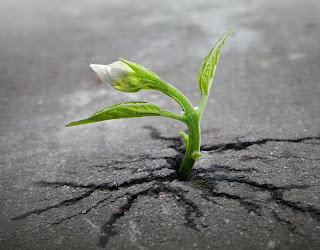
In a fascinating example of science fiction meets reality, researchers have begun integrating electronics into plants. While I'm sure this is an expensive and impractical venture at present, it still amazes me that this is real research people are doing somewhere in the world, and not (strictly) the premise to a science fiction novel. This article describes a study that involved using plant physiology to suck up a gel into their xylem (like plant veins), which hardens into working wires. They also managed to stick it to a cell layer in the leaves, creating a slightly different effect. Here is a direct quote from the aricle: Led by Eleni Stavrinidou—a bioelectronic engingeer at Linköping University in Linköping, Sweden—the scientists employed a transparent, conductive gel that cut roses could naturally soak up into their stems and leaves. After a few hours, the gel material would harden and form flexible wires inside the plants' stems. Thanks to the fantastic pro...